Showing posts with label OUDF401. Show all posts

27.3.12

Media specificity...

Medium = material or technic means of artistic expression.
Media = plural of medium.

The communication media is the product of our sad inability to communicate directly from mind to mind (sad indeed).
On the Phaedrus Socrates said that 'the alphabet created forgetfulness', and in some aspects it does make sense since now a days we use technology as an extension of our memory.
Humans have developed tools to use as extensions of our existing faculties and it has expanded in every single direction. In retrospective we could say that animation started because of the need of filling and artistic part that film couldn't do at the moment in time, just like film started by the urge of photographers of taking still images to the next level. The whole idea of innovation it's only a way of humanity to keep exploring and evolving and exploring new boundaries of different fields.
'Animation is not the art of drawings that move, but rather the art ofmovements that are drawn', noting 'what happens between each frame is more important than what happens on each frame'                                                                  Solomon 1987
Because of this happening at an alarming speed, we can say that now a days it's really easy to find same products or brands that are using as many media as possible to expand their creative range and at the same time to get as much public as possible.
Medium specificity is the view that the media evaluates a work o f art, design, etc using the media in the best way possible and in order for a medium to have characteristic qualities it must be grounded in a tradition that has established these qualities as intrinsic properties.
"An artwork, in order to be successful, needs to adhere to the specific stylistic properties of its own medium"                           Gotthold Ephraim Lessing 1776


World of Pokemon


This is my practical response to our transmedia project. I decided to go for Pokemon as my example since it's one of the biggest video games franchise (and because I still play the games).
For those who haven't play the game boy games, I suggest you do since I based this project on the intro of the original games.
Sorry about the million of spinning images, but I found myself in the middle of the project whit an overload of stuff to put on and not enough time.

20.3.12

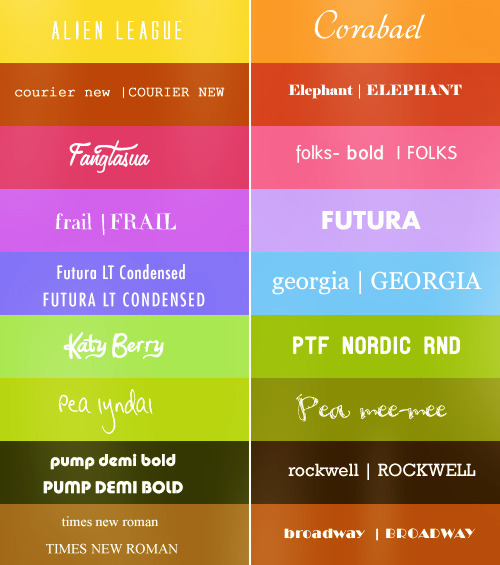
A History of Type

Having a little bit of a graphic design background I found the lecture on typography very interesting (11th of January).
Quite enjoyed the history bit behind it since it now brings a good reference to the different types of classifications:

- Humanist: imitating human handwritten and easy to read.
- Old style: rationalisation of the fonts.
- Transitional: scientific and mathematical order of the font (18th century)
- Modern: high contrast and ordered.
- Slab-serif (Egyptian): gets attention.
- Sans serif: simple and just to communicate.


Typography in animation and games is usually used to give an introduction or a 'feeling' of what the actual piece is going to be about. The using of title sequences is become an incredible useful part of any type of animation, and even now some games are using it as a type of trailer.

Some good example I've seen for 2D animation are openings for japanese animations (anime) and some of the biggest studios in that industry actually put good effort on them, since you get to see them on the beginning of every episode, having sometimes as a result, an opening with much better quality than the rest of the series.

Tank is the theme song for the opening credits of Cowboy Bebop composed by Yoko Kono. It has a mix of jazz and electric music and the text that appears moves and jumps according to the bases, and it also carries with the execution of the rest of the visuals.
Uses a basic palet of colours and it gives you a good introduction of the main characters focusing on the good design of the silhouettes.


Coraline is another good example of a good opening title sequence, because it not only gives you an idea with the font that it is a creepy type of story, but it actually set up some premises that are art of the story later on.
As a stop motion animation based on craft doll making, bottoms and thread are part of the titles and typography.


“Be careful what you wish for.”
With a descending doll all expectation is set aside at the start of author Neil Gaiman and director Henry Selick’s Coraline. Her punch-and-cut deconstruction is distressing; at her inversion you may feel a gastric tug. You may also dream of submissive needlepoint only to awake with new eyes.
To paraphrase the film’s series of alphabet posters, “‘C’ is for Coraline – brave little girl. Who unlocks the door to a whole different world.”


14.12.11

Italian Vernacular Cinema

film is not the art of scholars, but for illiterates 

Around 1970´s, working class italian used to go to the cinema every night as part of their daily life. Being transform into a habit, it became more of a social space where the convention of watching a film was different and talking, drinking and smoking during the show was common. It was divided according to classes; Prima and seconda visione was always in mayor cities and the audience selected the film to watch, while the terza visione was more of an industrial and rural area and the audience had limited choices and would watch the same films for a while.


This is the time where auteurs like Federico Fellini started introducing his films full of style and sophistication such as La Dolce Vita (1960) and 8 ½  (1963).

Other auteurs from the time that shared their own points of view about modernity, set pieces and eye line shot where pioneers to the new genre called Giallo, a mystery/horror that had place between 1970 and 1975 with films like The bird with the crystal plumage by Dario Argento (1970), The girl who knew too much by Mario Brava (1963) and Death walks on high heels by Luciano Ercoli (1971).

Speaking of the essence of this films and what the auteurs where trying to express, some of the contemporary films that we can find with similar aspects could be Black Swan (2010), Death Proof (2007), Dressed to kill (1980) and Black Christmas (1974)


30.11.11

The 'Auteur'

With an origin in the 1920's, but flourishing 1960 - 65 in where film directors started adding an individual style and taking complete control over all elements of their film production.
Having this creative control added a unique stamp and made this period in time an iconic season for the film industry.
Authors like Hitchcock manage to control the audience emotions (either european and american) by creating a surrealism, suspense and expressionism defined his style and made films like Psyco (1960), Vertigo (1958) and The Lodger (1927).

Now a days I find the director and producer Guillermo del Toro an inspiring and with some similar aspects that make films in which he has been involve iconic to mainstream audience; and also the fact that he's a world wide renowned director that comes from my city (Guadalajara, Mexico) makes it even more appealing to me. He worked on the Hellboy saga, Pan's Labyrinth and the coming The Hobbit, nothing more iconic than that (there is...but can't think of another mexican one) 


15.11.11

Street Art ~ Graffiti!


graffiti: : usu. unauthorized writing or drawing on a public surface

That's the definition of the Merriam-Webster dictionary, and several other dictionaries refer to the definition with synonyms of vandalism. 
Even though it could be considered to have its origin on cave's walls from the Paleolithic like the oldest one discovered in 1940 at Lascaux in France where there where starches made with animal bones and other natural paints. After that there are some other forms in Ancient Rome (Pompeii) and could be because of that the word itself comes from the word graffiato ("scratched") in italian.
Obviously the biggest wave of graffiti expresion started in the 1970's in New York having as a main feature the spay can graffiti that evolved along side the hip hop culture.

It was a way of announcing a presence, either a group or personal, but it was always a way to say 'we will not be ignored'. This was ended up making the language of the streets visible to other social groups.
From what I can relate to graffiti involved into my field, the first thing that comes to my mind is the video game Jet Set Radio for Dream Cast published by Sega, which is a game that describes the basics of life in Tokyo for a "rudie", a term used to refer to young people who roam the streets spraying and skating, as a means of self expression. The game was fantastic, but now that I think back, you where always being chased by a police officer and some other gangs... but the game play and the massive scenarios where fantastic! Also it had a unique artwork and an catchy soundtrack.


Also, there is this film-documentary called 'Exit Through the Gift Shop', filmed by the frenchman Thierry Guetta and featuring artist like Banksy, Shephard Fairey, Invader and many other of the world's most infamous graffiti artists at work. In here you can see the way that many contemporary street artist work, but most important, what they think and the reasons that pushes them to do what they do.


Despite the style and manifestation of graffiti, there are many artist that manage to express the main message through their work, but there's always the counter part of vandalism. It might be worth less making a piece of art while invading some else's property.

There are plenty ways in which now a days graffiti artists manage to express themselves without having to damage or concur to illegal procedures, like one of my favourite artist David Walker, who 'paints' on abandon vans and always creates beautiful pieces like the one underneath: 

Postmodernism ...

12th Oct 2011

It was a long time ago, but on that lecture/seminar we discussed about Postmodernism.
As a contrast of what modernism represents, the exhaustion, feeling of pluralism, the pessimism in society and the disillusionment with the idea of absolute knowledge were the main subjects in a postmodern mind.


Having its origin in the early 1917 with the german writer Rudolph Pannwitz when he made a reference of the "an-normal, post modern man".
From there, the term of 'postmodern' was used to represent the after modernity, contra modernism, 'late capitalism', artistic and stylistic eclecticism or the 'global village' idea of Globalisation.

After the end of Modernism (15 of July at 3:32pm, to be more precise, when the Demolition of the Pruitt-Igoe project took place - according to Charles Jencks), people started to develop an attitude as a reaction to modernism rules, and basically ended up having the no rules as the only rule (paradoxical...)
At some point it was celebrating what might otherwise be termed as Kitch and it also became against totalising the belief systems (metanarratives) such as religion as people developed a condition of incredulity.

Image of the fifth element showing the 'speed' of society and the unadaptable character to the environment.

As for art, the aesthetics became chaotic, and the complexity increased along with the mixing of materials and styles. Pin-up style and the re-using images as part of a parody became a common way of artistic expression.
This relationship between the city landscape and the artist was reflected in a crisis in confidence but that at the same time started to evoke ideas of freedom, of new possibilities and more important, to question old limitations.


Even though it's is a very vague term, it's clear that it caused a multiplicity of styles and approaches that still have effect in the aesthetics from now a days. Examples of it can be found in some animations like Akira by Katsuhiro Otomo (1988) or the film 'the 5th element' by Luc Besson (1997) where even when they express futuristic ideas, they keep having that idea of a Dystopian society where the image of police states or cities where technology has progressed far more rapidly than humanity's spiritual evolution and the government (or control source) has unlimited power over the citizens.

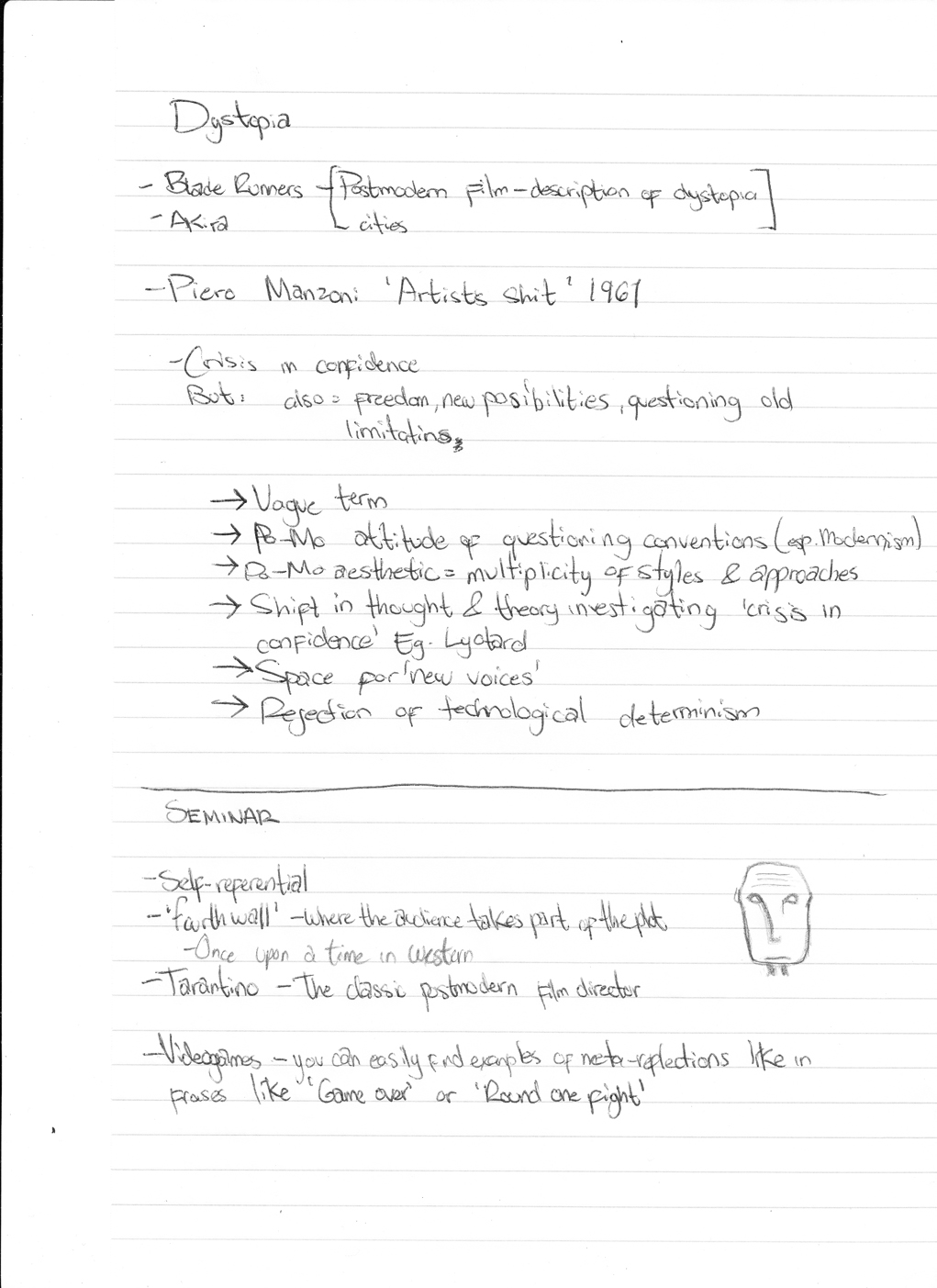
Notes!:


1.11.11

“Corporate Cannibal" - a frightening pulse


"... I'm a man-eating machine
you won't hear me laughing, as I terminate your day
you can't trace my footsteps, as I walk the other way..."
Those are parts of the lyrics coming out of a stretching, sinister silhouette that kept shifting from on an empty background.

As I was looking at the video from Grace Jones called "Corporate Cannibal" on the first seminar we had of Context of Practice all that came across my mind was "disturbing". That must have been because I had no clue what to expect and didn't had any knowledge of what context or purpose that video was made.

After analysing and watching it several times, it was still a bit disturbing, but paying attention to the lyrics you realize that this music video was not only made with the purpose to promote an artist; but it was a way to express a feeling, of at that time was starting to experience the feeling of globalization. It seems like a simple video at first sight; a white background and a woman being deformed by a computer effect, but once you analyise it, all those aspects seem to go a bit further and things start to make sense.

The woman is a human representation of 'technology' it self. As technology is based on an electric and algorithmic plane, the background takes a place an blank or empty space, yet infinite, where the contrast with the woman being black (and not as in a racial aspect) gives a bigger impact to the image creating a minimalist effect.
" my rules, you fools"
By doing the distortion of her body the whole body and most of the time in a vertical way, it gives an effect of constant movement and instability which is a particular characteristic of electricity; as if she was a modulating signal.

At some point, getting lost in the lyrics, it made you feel like you have no scape to the 'prophecy' she's singing; a no way back no matter what.

The sinister way of singing and the multiple expressions she performs during the video are apparently part of the tendency Grace Jones has; although most of the times she sings in some kind of feminist wave. This time she has mixed an aggressive style of fashion and a genuine concern among many contemporary sociologists and that is the near future effect of globalization in a network society.

This could be a perfect example of how there's no need to represent a song's lyrics in a literal and cinematic way, and instead making it a call for the mass to realize how corporations have no limit in their greediness.

"... I'll consume my consumers, with no sense of humour
I'll give you a uniform, chloroform
sanatize, homogenize, vaporize...you..."


6.10.11

Modern

5th Oct 2011


The subject of this lecture and seminar was Modernity & Modernism


During the years that I studied architecture I understood the importance of modernism as a complete change in any artistic/design conception.

The radical transformation that cities brought to society in ways that altered their way of living, way of thinking, way of expressing and more importantly, their way of feeling.
Society suddenly felt immerse in a routinary life, where consumerism starts attacking from every direction due to the easement that technology is bringing with the mass production
(cheaper and faster-made products), along with numerous inventions such as electricity, trains, telephone and photography.

Here's where the movement of the Bauhaus starts making an impact not only on architecture, but on other disciplines such as graphic design and industrial design. After some key strong influences, everything that was considered art becomes obsolete by the new idea of ‘less is more’ (Mies van der Rohe) in where the ornament becomes a crime (Adolf Loos). Starting with architecture, buildings became simple, exposing their material (new materials), creation of skyscrapers started after the invention of new constructive methods and the invention of the elevator. Then, as everything is linked, fashion and on-stage performances seem to be influenced; literature and painting are focusing deeply in the artist feelings which at the same time produce a big impact in psychology. This marked the beginning of the urban society as we know.

In general, the modernism became a subjective experience, the experience of the individual in the modern world; a response of the artists and their new modern life.

Frida Kahlo (Mexican painter)
is a perfect example of an artist reacting to her environment, which then became into a film.

Now, if we talk about contextualizing it with the present it is more or less the beginning of any form of animation and film, as the technology for it was just invented. Also it was the beginning of revolutionary thoughts with a futuristic vision (being the of sci-fi subjects) such as Metropolis or Things to come, which even now a days keep having some impact in many plots related to the future, robots and the way technology and massive amount of people affect the personal wrought, but at the same time the way the protagonist/artist is trying to survive/stand out.

Humans replaced by machines - a concept that is still used by every culture, in this case FLCL, a Japanese manga by Hajime Ueda.

Here's some of my notes taken in the lecture/seminar: